AI Strategy
Boosting Scenario Planning with Generative AI: From Latent Assumptions to Strategic Action | by Alan Mössinger | Dec, 2025 | Mediu
How combining a user-centric focus on the 'ghost scenario' with AI transforms scenario planning into a dynamic, continuous capability for strategic decision-making.
VEX AI-Tech Navigating Radical Uncertainty with Speed and Relevance
By VEX-AT-Tech from NotebookLM
VEX AI-Tech helps clients to speed up scenario planning by integrating Generative AI and human-centric into the workflow. We are discussing this interesting topic in this article and how we approach this current market volatility and strategize the enterprise’s future and make it stick.
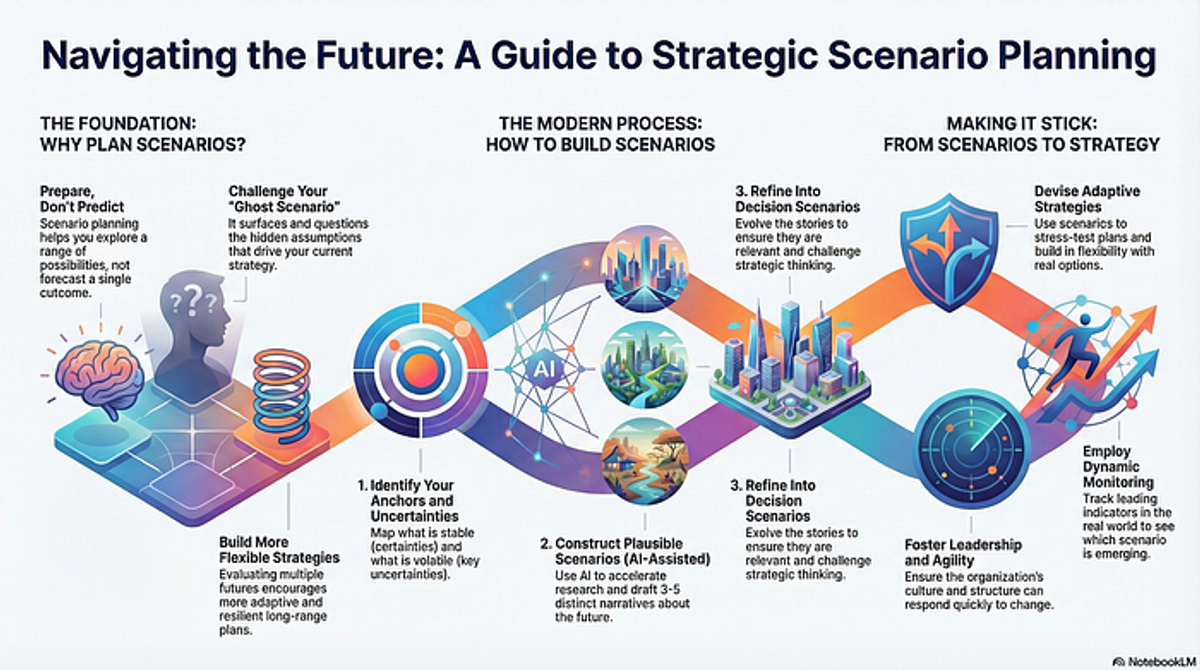
We operate in an environment of radical uncertainty, a landscape where conventional risk can no longer be priced, and traditional forecasting methods are insufficient. The convergence of political volatility, technological acceleration, and economic instability has corroded C-suite confidence and can lead to strategic paralysis. In this context, the imperative is not to predict the future but to prepare for it. Scenario planning offers a disciplined method for this preparation, helping organizations challenge assumptions, build resilience, and develop robust strategies that can perform regardless of how reality unfolds.
This guide introduces a core innovation to this trusted practice: a streamlined, AI-enhanced process that is faster, more relevant, and directly addresses the implicit beliefs that currently drive your strategy. We call this unstated set of assumptions the ‘ghost scenario’. Surfacing it is an act of strategic courage, and challenging it is the first step toward genuine resilience. By confronting this internal narrative with the collaborative power of Generative AI, organizations can transform scenario planning from a time-consuming, resource-intensive exercise into a dynamic capability.
Drawing on case studies from Nordic consumer goods company Fazer and U.K. employee benefits provider Unum Ltd., this guide provides a practical, step-by-step framework for strategy teams. It details how to implement a modern approach that delivers actionable insights with unprecedented speed, empowering leaders to navigate uncertainty with clarity and strategic foresight.
1. The Foundational Shift: From Traditional Scenarios to Challenging the ‘Ghost Scenario’
Before implementation can begin, teams must understand the fundamental evolution in scenario planning that this guide champions. The strategic value has shifted from exploring generic external possibilities to a highly targeted examination of the organization’s own implicit vision of the future. This user-centric approach anchors the entire exercise in the mental maps of decision-makers, ensuring immediate relevance and impact.
1.1. Defining the ‘Ghost Scenario’
The ‘ghost scenario’ is the often unstated and implicit set of assumptions about the future that underpins a company’s current strategy and investments. It is the future that senior leaders are already betting on, even if they haven’t articulated it as a formal scenario.
Surfacing this ghost scenario is the critical first step in the modern process. It makes the entire exercise immediately relevant to decision-makers by focusing on the beliefs that already shape their perceptions and actions. Instead of building alternative futures in a vacuum, the team develops scenarios designed specifically to question, enrich, and re-evaluate the prevailing worldview. This avoids the common pitfall of creating scenarios that are interesting but strategically inert, ensuring the work is anchored in what matters here and now. Making these assumptions explicit is the most direct path to forging a truly robust strategy, because you cannot defend against threats you refuse to name.
1.2. The Role of AI: Your Ideation Partner and Accelerator
In this framework, Generative AI, particularly Large Language Models (LLMs), is not treated as an objective source of truth but as a powerful collaborator for research, ideation, and narrative creation. Its function is to augment human thinking, challenge groupthink, and dramatically accelerate the process.
The impact of this integration is quantifiable. Based on the experiences at Fazer and Unum, the judicious use of AI can reduce the time required to produce scenario outputs — such as detailed narratives and supporting media — by 40% to 50%. This efficiency is achieved through an “AI-in-the-loop” model, which keeps human reasoning at the center. Leaders use AI to brainstorm ideas, access a vast range of information beyond the company’s boundaries, and spark imaginative thinking. Humans remain responsible for strategic judgment, plausibility assessments, and final decision-making, using the AI’s output as a powerful catalyst for deeper strategic conversation.
With this conceptual framework in place, the first practical step is to turn inward and identify your organization’s own ghost scenario.
2. Phase 1: Surfacing and Targeting Your Core Assumptions
This phase puts the organization’s strategy on the operating table. Its purpose is to surgically identify the handful of foundational beliefs upon which the entire enterprise rests, which will then become the focal point for the entire scenario-building effort.
2.1. Step 1: Identify the Intended Users and Strategic Decisions
Before any analysis begins, you must clearly define the primary audience and purpose of the scenarios.
- Who is the user? First, define the primary audience. Is it the C-suite, a specific business unit leadership team, or another group of decision-makers? Tailoring the scenarios to the unique worldview of the intended user is paramount.
- What decisions will this inform? Next, clarify the specific, high-stakes decisions the scenarios are meant to influence. Examples include a five-year strategic plan, a major capital investment in new technology, or a market entry strategy.
Answering these questions ensures the final output is directly applicable and speaks a language that resonates with those who will act on it.
2.2. Step 2: Extract the Ghost Scenario Assumptions
With the users and decisions defined, the next step is to make the implicit ghost scenario explicit. There are two effective methodologies for this, as demonstrated by the case studies.
The Interview-Based Method (Do)
The Document Review Method (Unum Ltd.)
This method involves directly engaging with senior leadership to uncover their unstated beliefs about the future. The process includes conducting interviews with senior managers to compile a comprehensive list of commonly held assumptions that are implicitly guiding current strategic thinking and investments.
This method extracts assumptions from the organization’s existing strategic artifacts. The process involves a thorough review of corporate materials such as current strategy documents, board minutes, investor relations announcements, and internal communications to distill the underlying assumptions that justify the company’s direction.
2.3. Step 3: Select 3–5 Critical Assumptions to Challenge
The list of assumptions from Step 2 must be strategically narrowed to a manageable few. This is not an exercise in consensus; it is a high-stakes triage. The goal is to identify the assumptions that are simultaneously most critical to your current strategy and most vulnerable to disruption. Focus on the 3 to 5 most salient and interesting assumptions to challenge, preventing the process from becoming too broad or “boiling the ocean.” This sharp focus ensures the resulting scenarios are powerful and directly relevant.
This selection must be made in close consultation with the intended users (top management). As seen at both Fazer and Unum, presenting the initial list of assumptions to leadership for validation and prioritization is crucial. This collaborative step secures their buy-in and confirms that the scenarios will address the uncertainties they find most pressing, whether these are gut feelings about over-reliance on a trend or concerns about wishful thinking.
With the core assumptions targeted for challenge, the diagnostic phase is complete. The process now transitions to the creative work of building plausible alternative futures.
3. Phase 2: Building Plausible Alternative Futures With AI
In this phase, the team moves from deconstruction to construction. The goal is to create a set of plausible, challenging, and internally consistent scenarios that directly contrast with the selected ghost scenario assumptions. This grounding is a critical bridge between deconstruction and construction. By first identifying the certainties that form the ‘guardrails’ of the future (the focus of Step 3.1.1), we create a stable foundation upon which to explore the volatile uncertainties that will challenge our ghost scenario. Generative AI is used here to enhance both the speed and the richness of the creative process, turning abstract concepts into compelling narratives.
3.1. Step 4: Researching and Grounding the Scenarios
Robust scenarios must be grounded in reality. This requires a balanced understanding of both the stable elements that will likely persist (certainties) and the volatile forces that could drive change (uncertainties).
3.1.1. Identifying Certainties (The Guardrails)
Certainties, or “predetermined elements,” are the boundary conditions that anchor your scenarios in plausible reality. They are the load-bearing structures upon which volatile uncertainties play out. To identify them, analyze your strategic environment through these five lenses:
- Material and physical: Forces rooted in geography, physical infrastructure, natural resources, and environmental ecosystems that resist quick change.
- Knowledge- and expert-driven: Dominant knowledge regimes, standardized metrics, or expert systems that define what is considered “true” or viable in your industry.
- Temporal and path-dependent: The inertia of past decisions, long planning cycles, and intergenerational commitments that are difficult to reverse quickly.
- Political and economic: Entrenched policies, market structures, or financial commitments actively defended by powerful vested interests.
- Normative and cultural: Enduring societal values, organizational principles, or shared narratives that shape what is seen as legitimate or inevitable.
3.1.2. Exploring Uncertainties with AI
With the certainties providing a foundation, the next step is to explore the key uncertainties that challenge the ghost scenario. LLMs are an invaluable tool for this research, enabling teams to quickly identify factors, data sources, and arguments that can broaden their perspective. Following Unum’s approach, teams can use AI as an ideation partner.
Example Prompt:
“You are an expert scenario planner. Provide compelling arguments that both support and contradict the assumption that [insert ghost scenario assumption], citing links to credible research papers and institutional reports.”
This approach uses the LLM not for a final answer, but to streamline the research process and surface credible sources that the team can then investigate directly.
3.2. Step 5: Developing Scenario Narratives and Visuals
3.2.1. The Workshop Process
A collaborative workshop is the core of scenario development. Drawing on the Do and Unum examples, this session brings together subject matter experts from across the organization. The workshop should involve:
- Presenting Research: Share the findings on certainties and uncertainties.
- Critiquing Hypotheses: Encourage participants to challenge the assumptions and contribute their own perspectives.
- Mapping Scenarios: Use tools like opposing-hypothesis cards (e.g., “AI creates high-skilled jobs” vs. “AI causes widespread job displacement”) to help teams map plausible sequences of events that lead to distinct future outcomes.
3.2.2. Generating Narratives with AI
The outputs from the workshop — such as thematic descriptions and event maps — serve as excellent prompts for an LLM to craft vivid, detailed narratives for each scenario. This transforms bullet points and hypotheses into engaging stories.
Example Prompt:
“Based on the following 250-word description from our workshop, write a captivating narrative from the perspective of a person living in the year 2040 in this scenario. Incorporate insights about [insight X], [insight Y], and [insight Z].”
3.2.3. Enhancing Engagement with AI-Generated Media
As Unum demonstrated, AI can also be used to create compelling visual media, such as short videos illustrating each scenario. This has a profound strategic impact:
- Reduces Misinterpretation: A visual format ensures everyone is on the same page, creating a shared understanding of each future.
- Boosts Engagement: Videos are a powerful tool for capturing the attention of executive teams and facilitating more meaningful and dynamic strategic discussions.
- Serves as a Reusable Asset: The videos can be easily shared throughout the organization to socialize the scenarios and stimulate broader strategic thinking.
The scenarios have now been created. The final phase focuses on putting them to work to drive strategic action and build lasting organizational resilience.
4. Phase 3: Activating Scenarios for Strategic Impact and Resilience
The creation of scenarios is not the end goal. The true value is realized only when they are actively used to test, refine, and future-proof strategy. This phase details how to embed the scenarios into the organization’s strategic DNA, transforming foresight into action.
4.1. Step 6: Ensuring Scenarios Inform Strategic Dialogue
The final scenarios must be integrated into the highest levels of strategic conversation.
- Use Compelling Formats: As seen at Unum, present scenarios through engaging media like videos. This format facilitates a deeper, more nuanced discussion among leadership by establishing a shared understanding quickly.
- Integrate Into Existing Processes: To avoid scenarios being treated as a one-off exercise, embed them into the formal strategy process. Follow Fazer’s model by requiring each business or functional unit to formally assess the company’s strategy against each scenario, outlining key topics, risks, opportunities, and potential responses for each plausible future.
4.2. Building the Connective Tissue to Make Scenarios Stick
For scenario planning to become an ongoing capability rather than an isolated project, it must be supported by complementary organizational practices. Scenarios that exist only in reports are strategically useless. The practices outlined below are the organizational ‘connective tissue’ required to translate foresight into action, ensuring the scenarios live on in budgets, behaviors, and leadership dialogues.
- Devise Adaptive Strategies Scenarios provide the context for building strategic flexibility. Use them to identify “no regret” moves — actions that are beneficial across all plausible futures — and to develop a portfolio of “real options.” This options-thinking approach involves making smaller initial investments to gain a foothold in a potential opportunity, waiting until key uncertainties become clearer, and only then deciding whether to commit more fully. This allows the organization to adapt its strategy as the future unfolds. This approach requires a profound shift in mindset: embracing strategies that prioritize flexibility, even if they are not the most seemingly optimal or efficient choice for present-day conditions.
- Employ Dynamic Monitoring An effective scenario process includes creating an “early warning system.” For each scenario, identify a set of unique leading indicators — measurable signals that would suggest that particular future is beginning to emerge. This monitoring system should track the external macro environment, scanning for weak signals that foreshadow how events may change the business landscape. This allows the organization to recognize, before its competitors, which way the world is headed.
- Improve Organizational Agility Scenarios reveal the types of disruptions and opportunities an organization might face, highlighting the need for agility. Agility is the ability to mitigate unanticipated disruptions and seize short-lived opportunities quickly. The insights from scenario planning should directly inform efforts to build a more agile organization, whether by streamlining decision-making, creating more flexible resource allocation processes, or developing adaptive supply chains.
- Foster Decision-Making Savvy Scenarios are designed to challenge the very cognitive biases — such as overconfidence, anchoring, and groupthink — that can lead to strategic failure. To capitalize on this, the organization must actively cultivate decision-making savvy. This includes training managers to recognize common decision traps and using the scenarios as a tool for “mental rehearsal,” priming them to see the world kaleidoscopically and make better choices under pressure.
- Cultivate Visionary Leadership Leadership is the ultimate buffer against uncertainty. Leaders must champion the scenario process, absorb the residual uncertainty for the organization, and use the scenarios to create meaning, rekindle hope, and build alignment. Their role is to foster a culture that is comfortable with ambiguity and prepared to change course decisively when a shift in the strategic environment is detected.
With the scenarios now integrated into the strategic fabric of the organization, it is vital to reflect on best practices and common pitfalls to ensure long-term success.
5. Best Practices and Pitfalls to Avoid
This final section provides critical guidance to ensure the successful and sustainable execution of the AI-enhanced scenario planning process. It highlights proven techniques for working with AI and identifies common decision-making traps that this methodology is designed to overcome.
5.1. Three Non-Negotiable Rules for Using Generative AI
Successfully integrating LLMs into scenario planning requires a disciplined and thoughtful approach. The experiences of Fazer and Unum distill into three key best practices:
- Prompting Is a Process, Not an Event Effective prompting is an iterative, running thread throughout the project. It is not a one-off activity but a continuous dialogue with the AI to refine ideas, deepen research, and craft narratives. Treat the LLM as a creative partner to be guided and directed through a series of interactions.
- Validate All Outputs Treat LLM outputs as “raw” material, not as finished intelligence. It is essential to have a validation protocol. As Fazer and Unum demonstrated, this can involve checking the sources an LLM cites to assess their credibility or consulting with external subject-matter experts to review the plausibility of AI-generated insights and scenario descriptions.
- Maintain Human-Centered Reasoning The “AI-in-the-loop” model is non-negotiable. Strategic judgment, critical thinking, and the assessment of plausibility must remain human responsibilities. The role of AI is to augment and accelerate human cognition, not replace it. Humans must stay at the center of the reasoning process, making the final calls on what is relevant, useful, and strategically sound.
5.2. Common Dysfunctional Patterns in the Face of Uncertainty
Radical uncertainty often triggers counterproductive decision-making patterns. This AI-enhanced scenario process is explicitly designed to help leaders avoid these two common traps:
- Overindexing on Short-Term Signals This is the tendency to magnify the meaning of a single day’s news, a social media post, or an individual data point. It leads to frantic oscillations between optimism and pessimism and results in reactive, inconsistent decision-making. Scenario planning counteracts this by providing a stable, expansive map of possibilities, allowing leaders to place new information into a broader context rather than treating every signal as a crisis.
- The Search for False Certainty When overwhelmed by uncertainty, teams often anchor on a single point-prediction to quell anxiety. This provides a fleeting sense of relief but is strategically dangerous, as it leads to “betting the farm” on one outcome while ignoring or dismissing contingency plans. By exploring multiple, equally plausible futures, scenario planning forces leaders to embrace uncertainty and prepare for a range of outcomes, fostering resilience instead of false confidence.
6. Conclusion
By combining a user-centric focus on the ‘ghost scenario’ with the speed and creative power of AI, organizations can transform scenario planning from a periodic, resource-intensive exercise into a dynamic, continuous capability. This modern approach does more than just prepare an organization for different futures; it forges a perpetual state of readiness, transforming the organization from a passive reactor to future shocks into an active architect of its own enduring success.
About the Author
Alan Mössinger is a global CEO, AI specialist and strategist leading VEX AI-Tech and VEX Holding across the U.S., Europe, and Latin America. With two decades of experience at the intersection of energy, data science, and digital transformation — including leadership roles at Petrobras and advanced executive studies at MIT Sloan, Stanford Engineering, Harvard Business and Michigan Information — he specializes in applying AI to complex decision-making under uncertainty. Alan is a recognized thought leader with 45+ published articles on energy transition, AI governance, and strategic innovation, helping executives navigate the profound shifts reshaping global industries.
References:
Drover, Will, and Laura Huang. “The Forces That Shape AI’s Uneven Progress.” MIT Sloan Management Review (Winter 2026, Vol. 67, №2).
Phadnis, Shardul, Chris Caplice, and Yossi Sheffi. “How Scenario Planning Influences Strategic Decisions.” MIT Sloan Management Review (2016),.
Ramírez, Rafael, Trudi Lang, Joakim Köhler, and Matt Mennell. “A Faster Way to Build Future Scenarios.” MIT Sloan Management Review (Winter 2026, Vol. 67, №2).
Schoemaker, Paul J.H. “Scenario Planning: A Tool for Strategic Thinking.” MIT Sloan Management Review (Winter 1995).
Schoemaker, Paul J.H., and Shardul S. Phadnis. “How to Make Scenario Planning Stick.” MIT Sloan Management Review (Winter 2026, Vol. 67, №2).
Selin, Cynthia. “Assess What Is Certain in a Sea of Unknowns.” MIT Sloan Management Review (Winter 2026, Vol. 67, №2).
Weber, Steven. “Scenario Planning Amid Radical Uncertainty.” MIT Sloan Management Review (July 2025).