AI Strategy
Superagency: How AI Moves Humanity Beyond Scarcity
The Intelligence Age won’t be defined by what machines can do — it will be defined by what humans choose to build with them.
The Intelligence Age won’t be defined by what machines can do — it will be defined by what humans choose to build with them.
Introduction
For the vast majority of human history, progress was a slow climb against the gravity of scarcity. Every previous revolution — agricultural, industrial, digital — automated muscle or mechanized routine. What is happening now is structurally different. We are automating cognition itself, and the economics of that shift follow rules that have no historical precedent.
This is the Intelligence Age. Not a marketing label, but a measurable structural change in how value is created, how diseases are treated, and how individuals access the tools of high-level thinking.
The cost of cognitive work — analysis, synthesis, translation, code generation, pattern recognition — is falling on an exponential curve. That single fact rewires industries, institutions, and the very definition of scarcity. And it raises a question that cannot be deferred: if intelligence becomes abundant and nearly free, what do we build with it, and who gets to decide?
This essay lays out what is real, what is likely, and what remains speculative — and argues that the defining challenge of the next decade is not whether AI transforms civilization, but whether we build the governance and intentionality to ensure it transforms civilization well.
1. Intelligence Is Deflationary — And That Changes the Math on Everything
Every previous industrial revolution automated muscle. This one automates cognition. That distinction matters because cognitive work is the bottleneck in nearly every value chain on Earth — from drug discovery to legal review to software engineering to education.
The scaling behavior of modern AI follows a rough relationship: capability improves proportionally to the logarithm of invested resources (compute, data, energy). In plain terms:
Capability ≈ k · log(Resources)
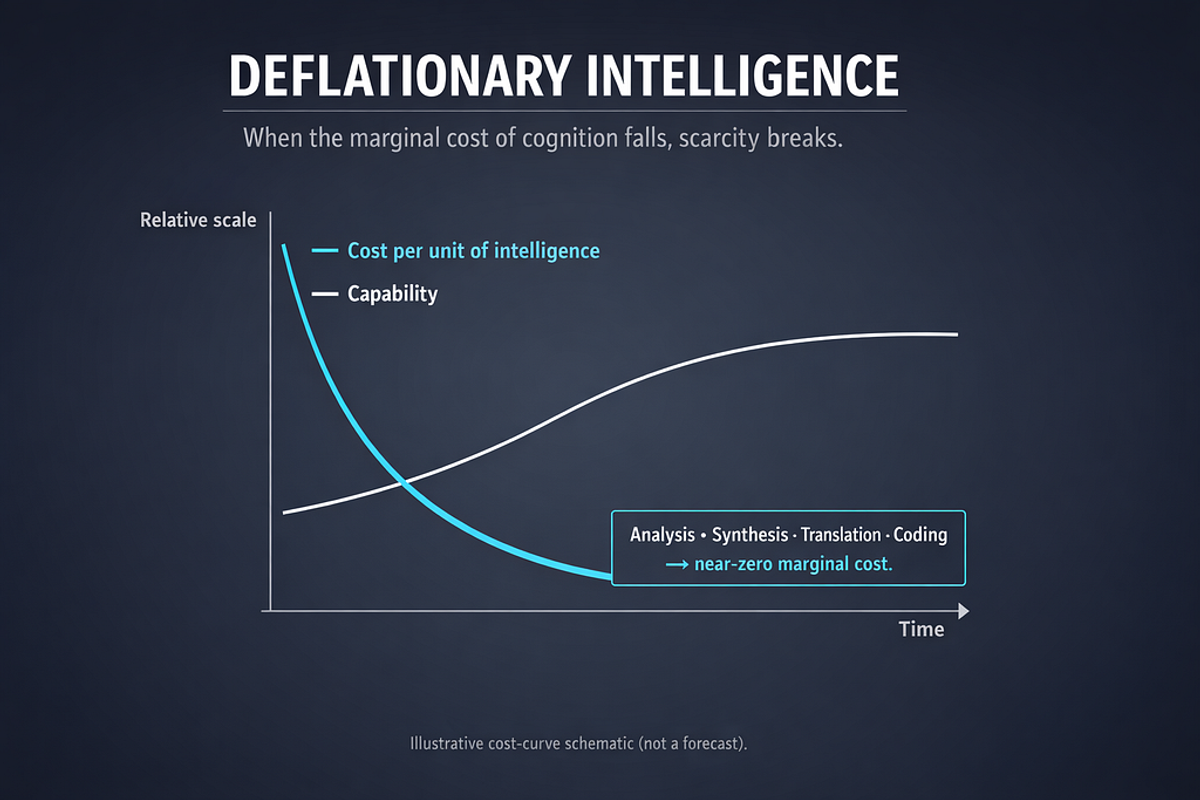
A rough way to describe scaling is that each doubling of compute/data tends to deliver a predictable incremental gain, even though marginal returns per additional unit of resource diminish; furthermore, as competition among labs is driving aggressive optimization, the cost per unit of intelligence is collapsing. Between early 2023 and mid-2024, the price per token for frontier-class models fell by roughly two orders of magnitude. By some estimates, the cost of a given level of AI performance drops approximately 10x every 12 months — a pace that makes Moore’s Law look leisurely.
The macro implication is what I call deflationary intelligence: when the cost of analysis, synthesis, translation, coding, and pattern recognition approaches zero, the traditional constraints that made goods and services expensive begin to dissolve. Healthcare diagnostics that required a specialist and a six-month wait can be triaged in seconds. Legal documents that cost $800 per hour to draft can be generated for pennies. Educational tutoring that was available only to the affluent becomes universally accessible. (Figure 1)
This isn’t utopian projection; it’s the direction implied by the cost curve — though institutions adopt unevenly. It is cost-curve arithmetic. The question is not whether these shifts happen, but how fast adoption diffuses through institutions — and who captures the value.
Figure 1 — Deflationary Intelligence
2. The Reality Check: What’s Happening Now vs. What’s Next
One of the most corrosive habits in AI discourse is treating speculation as certainty (Figure 2). Here is how to calibrate the timeline honestly:
Figure 2 — The Reality Check
What is already happening (2023–2026 evidence). Frontier models routinely outperform median human performance on standardized tests, coding benchmarks, and medical licensing exams. AI-generated code accounts for a growing share of production software at major tech firms. Drug candidates identified by AI systems have entered clinical trials. Cost curves continue to steepen. Enterprise adoption is real but uneven — concentrated in tech, finance, and pharma, with slower uptake in manufacturing, government, and education.
What is likely in the next 3–7 years (if current trends hold). AI agents that autonomously execute multi-step workflows — research, draft, review, iterate — will become standard enterprise tools. Seventy percent of current job skills will likely shift, not vanish, but reshape dramatically. Personalized medicine powered by AI protein-structure prediction and genomic analysis will move from research novelty to clinical standard of care. AI tutoring systems will begin closing educational gaps at scale in countries that invest in infrastructure.
What remains speculative (10–20+ years). Artificial General Intelligence — a system matching human-level reasoning across all domains — has plausible but uncertain timelines. Credible researchers place it anywhere from the late 2020s to decades away; the honest answer is that nobody knows with precision. Claims about “longevity escape velocity” (the point at which medical advances extend life expectancy by more than one year per year) are theoretically grounded but depend on cascading breakthroughs in gene therapy, epigenetic reprogramming, and regulatory approval pipelines that are inherently unpredictable. The “Singularity” — a hypothetical intelligence explosion — remains a scenario, not a forecast.
It is more useful to plan for a range of futures than to bet on a single timeline.
3. Superagency: The Amplifier, Not the Replacement
The concept at the center of this thesis is Superagency: the state in which AI acts as an amplifier of human intent rather than a substitute for human judgment. (Figure 3)
Figure 3 — Superagency
Here is what this looks like in practice. A first-generation college student in rural South America can now use AI to draft a research proposal at a quality level that previously required mentorship from a well-connected professor. A solo entrepreneur can deploy a customer service system that would have required a ten-person team three years ago. A nurse practitioner in a remote clinic can access diagnostic reasoning that was once confined to academic medical centers.
Superagency is not about replacing expertise. It is about collapsing the distance between potential and execution. The barriers that made talent, geography, and capital prerequisites for innovation are becoming optional. The scaffolding is going up for everyone, not just those who could already reach the top shelf.
This is the most egalitarian force in modern technology — but only if access, literacy, and governance keep pace with capability.
4. The “Learn-It-All” Imperative
If intelligence becomes cheap and abundant, what remains scarce? Judgment. Context. The ability to ask the right question. Emotional intelligence. The willingness to be wrong and learn fast.
The organizations that will thrive in the Intelligence Age are not those with the most technical talent — AI can supplement technical talent. They are the organizations that cultivate what Satya Nadella has called a “learn-it-all” culture over a “know-it-all” culture. When AI handles the analytical scaffolding — the data wrangling, the pattern detection, the first-draft synthesis — the human differentiator shifts to empathy, creative framing, ethical judgment, and the ability to navigate ambiguity.
This is the largest change management exercise in corporate history, and most organizations are not ready for it. The companies treating AI as a line-item technology purchase rather than a fundamental redesign of how work gets done will find themselves outpaced by leaner, more adaptive competitors.
The practical directive for any leader: do not start with the technology. Start with your people. Map the skills that AI will augment, the skills that AI will make obsolete, and the skills that will become more valuable because AI handles everything else. Then invest accordingly.
5. Biology’s Breakthrough Moment
The Intelligence Age is already delivering results that were considered impossible a decade ago.
For fifty years, Levinthal’s Paradox haunted biochemistry: a single protein could theoretically take longer than the age of the universe to explore all its possible three-dimensional configurations. DeepMind’s AlphaFold helped crack protein structure prediction at scale, enabling predicted structures for ~200 million proteins in AlphaFold DB — work recognized by the 2024 Nobel Prize in Chemistry. This was not incremental progress. It was the kind of discontinuity that redraws the map of what science can do.
Building on this foundation, AI-assisted gene editing is moving from laboratory theory to clinical reality. In 2025, clinicians and researchers rapidly developed a personalized CRISPR-based therapy for an infant (K.J.) with CPS1 deficiency — an early proof that bespoke gene therapies can be created on clinically relevant timelines. The phrase “untreatable genetic disease” is acquiring an expiration date.
If current trajectories in AI-accelerated drug discovery, gene therapy, and epigenetic research continue, the 2030s may see meaningful extensions in healthy human lifespan. This is not a guarantee — regulatory, ethical, and technical obstacles remain formidable — but the research pipeline is more promising than at any point in history. We are not just reading the code of life. We are learning to debug it.
6. The Constraints Nobody Wants to Talk About
No honest assessment of the Intelligence Age can ignore its binding constraints.
Energy and compute. Training frontier AI models consumes enormous quantities of electricity. The data center buildout required to sustain current scaling trends is already straining power grids in key regions. If we are serious about AI-driven abundance, we must simultaneously solve for clean, scalable energy — nuclear, advanced geothermal, next-generation solar — or the Intelligence Age will hit a physical ceiling before it delivers on its promise.
Geopolitics and concentration risk. The production of advanced AI chips is concentrated in a handful of fabrication facilities, primarily in Taiwan and South Korea. Export controls, data sovereignty regulations, and strategic competition between the United States and China are shaping which countries and companies can participate in the frontier. This is not a theoretical concern; it is an active policy battleground with real consequences for who benefits from AI and who is excluded.
Trust and adoption. Enterprise AI adoption is moving faster than organizational readiness. Most companies lack the internal governance, data infrastructure, and workforce training to deploy AI safely and effectively. The gap between what AI can do and what organizations actually do with it remains the largest bottleneck in the system.
7. Governance: What to Build In from Day One
The Intelligence Age will not govern itself. Every system deployed should incorporate accountability from the outset — not as an afterthought, not as a compliance checkbox, but as architecture. Right now, governance is lagging capability. (Figures 4 and 5)
Transparency. Users and affected parties must understand when AI is making or influencing decisions. Black-box systems erode trust and prevent meaningful oversight.
Auditability. Every consequential AI system should produce logs and explanations sufficient for independent review. If you cannot audit it, you should not deploy it.
Alignment and safety. As AI systems become more capable, the effort invested in ensuring they remain aligned with human values and intentions must scale proportionally. This is an engineering discipline, not a philosophical afterthought.
Labor transition. Governments and companies must invest in reskilling at a pace commensurate with displacement. The phrase “creative destruction” is cold comfort to someone whose livelihood disappears before alternatives exist.
Preventing concentration of power. If the benefits of AI accrue only to those who control the largest models, the most data, and the most compute, we will have replaced one form of scarcity with another. Open research, interoperability standards, and deliberate policy design are essential counterweights.
Figure 4 — Governance is architecture
The question is not whether we can build powerful AI. The question is whether we can build the institutional scaffolding to match.
Figure 5 — Intelligence Age Scorecard
8. The Invitation
The pattern visible across every previous technological transition is consistent: the winners are not those who predicted the future most accurately, but those who built the capacity to adapt fastest. The Intelligence Age is no different.
It is not arriving in 2045. It is arriving now — unevenly, imperfectly, with enormous promise and genuine risk. The next 12–24 months are a window of unusual leverage. Here is what leaders, builders, and citizens should do with it:
Leaders: Redesign your organization around augmented workflows, not automated roles. Invest in your people before you invest in your models. The companies that treat AI as a workforce multiplier rather than a headcount reducer will build durable advantages.
Builders: Ship systems with built-in governance. If you would not want your deployment audited on the front page, redesign it before you launch. Safety and capability are not opposing priorities — they are the same priority on different timescales.
Citizens: Develop AI literacy the way previous generations developed financial literacy. Understand what these tools can and cannot do. Demand transparency from the institutions that deploy them. Your agency in the Intelligence Age depends on your ability to distinguish signal from hype.
The Intelligence Age offers something unprecedented: the possibility of a world where human potential is no longer rationed by geography, capital, or circumstance. That is what Superagency means — not a technology, but a condition. A world where the distance between having an idea and executing it collapses. Where the scaffolding of intelligence is available to anyone willing to climb.
But abundance is not automatic. It must be designed, governed, and fought for.
How will you choose to use your Superagency when the cost of a great idea falls toward zero?
If this resonated, follow me for more on AI strategy, Enterprise AI, AI governance, and the systems shaping the Intelligence Age.