AI Strategy
CCUS Executive ROI
Carbon Capture, Utilization, and Storage (CCUS) is rapidly evolving from climate obligation to strategic asset class. This executive guide explores market growth, policy catalysts, carbon pricing dynamics, and a three-pronged framework to unlock ROI from CCUS investments.
ROI from CCUS: An Executive Strategy
An Executive’s Guide to Capturing Value in the CCUS Revolution
Introduction
In the race toward net-zero emissions, Carbon Capture, Utilization, and Storage (CCUS) has emerged as more than an environmental imperative — it’s becoming a strategic asset class that demands executive attention. As we navigate this rapidly evolving landscape, understanding the ROI potential of CCUS investments becomes essential for strategic planning and sustainable growth. Drawing from my two decades of experience in energy and technology leadership, I share insights on evaluating and maximizing returns from CCUS initiatives.
My analysis indicates that organizations embracing comprehensive CCUS strategies now will be best positioned for sustainable growth and competitive advantage in the coming decades.
The Strategic Landscape
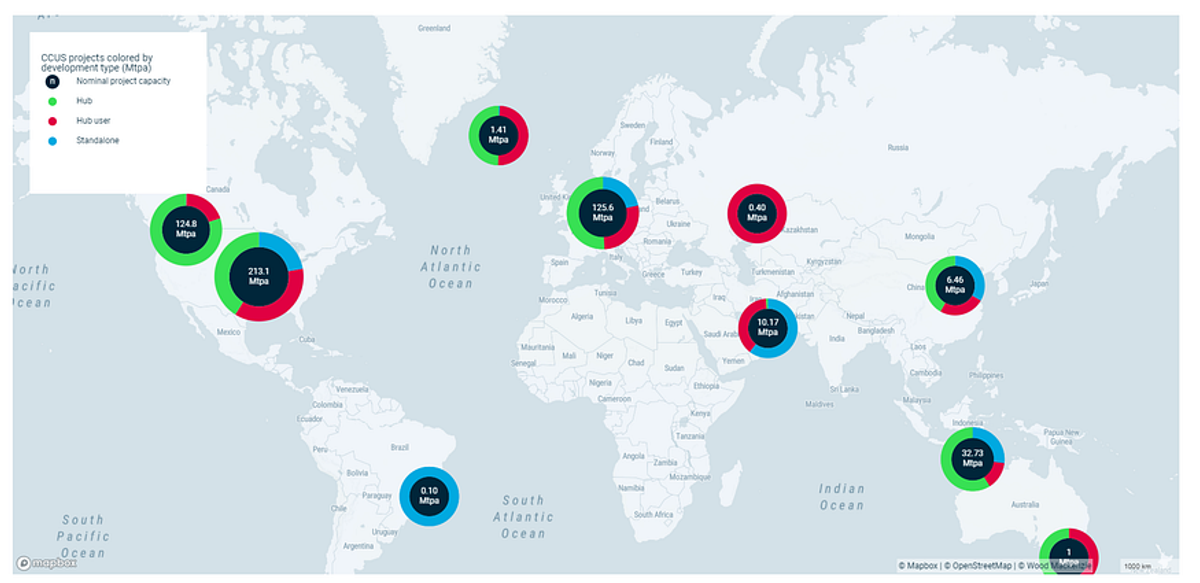
The CCUS market presents a compelling growth story, projected to reach USD 37.5 billion by 2033 from its current USD 6.9 billion valuation. A global analysis of current project development reveals the scale and geographic distribution of this opportunity:
Press enter or click to view image in full size
Figure 1: Global CCUS Projects by Development Type (Mtpa). Source: Wood Mackenzie Lens Carbon, 2024
Figure 1 illustrates that North America leads with over 337.9 Mtpa of total capacity in development, followed by significant hubs in Europe (125.6 Mtpa) and Asia-Pacific, notably Australia (32.73 Mtpa). The detailed breakdown between hubs, hub users, and standalone projects provides critical insights for strategic positioning along the CCUS value chain.
Policy Evolution and Market Dynamics
Policy is a crucial catalyst for CCUS investment. Recent global regulatory developments are reshaping the market:
Press enter or click to view image in full size
Figure 2: Global Carbon Border Tax Development Status. Source: Wood Mackenzie Lens Carbon, 2024
Figure 2 shows how initiatives such as the EU’s Carbon Border Adjustment Mechanism (CBAM), which began financial obligations in 2026, are spurring similar measures worldwide. With the UK’s planned 2027 implementation, new proposals in the U.S., and emerging policies in Asia-Pacific, governmental support for carbon reduction technologies is rapidly expanding
Market Mechanisms and Standards
As carbon markets mature, the evolution of market standards is creating robust opportunities for value creation. Standardization is key to investor confidence:
Press enter or click to view image in full size
Figure 3: CORSIA Eligibility Standards and Registry Status. Source: Wood Mackenzie Lens Carbon, 2024
The evolution of carbon credit standards shows increasing sophistication in market mechanisms (Figure 3). Six standards have received full approval for CORSIA’s first phase, while five others maintain conditional approval status. This standardization is crucial for market confidence and project development. This differentiation underscores a market preference for permanent carbon removal solutions.
Price Trends and Value Creation
Understanding price dynamics is essential for project planning. The following trend analysis highlights the premium for removal credits:
Press enter or click to view image in full size
Figure 4: Carbon Offset Prices by Type (2015–2024). Source: Wood Mackenzie Lens Carbon, 2024
Figure 4 shows that removal credits have reached USD 12/tCO₂e by 2024, significantly outpacing avoidance/reduction credits. This differentiation underscores a market preference for permanent carbon removal solutions.
A Strategic Framework for Implementation
Drawing on my experience in digital transformation across the energy sector — as discussed in articles like “The Executive Playbook for Leading the New Energy Era” (Jan 28, 2025) and “Bridging Traditional Industries and the Digital Future” (Feb 8, 2025) — I propose a three-pronged framework for capturing value in CCUS:
1. Strategic Project Selection
The shift from announcements to execution demands rigorous evaluation frameworks. Success requires balancing multiple factors:
- Policy Support: Government incentives have transformed project economics. The US 45Q tax credit now offers up to $85 per tonne for geological storage and $180 per tonne for Direct Air Capture projects.
- Market Dynamics: The compliance carbon pricing landscape continues to evolve, with new national ETS launches in Turkey and Colombia, and state-level developments like New York’s upcoming ETS launch in 2025.
- Scale Economics: Larger projects benefit from reduced per-unit capture costs and optimized infrastructure utilization.
2. Technology Integration
Having led digital transformation initiatives across energy sectors, I’ve learned that technology selection must balance current capabilities with future scalability. Success stories like the Quest CCS Facility in Alberta, which exceeded capture targets by 30% while achieving significant cost reductions, demonstrate the importance of operational learning and continuous improvement.
The emergence of commercial CO2 shipping in 2025, marked by projects like Northern Lights, shows how technological advancement can open new market opportunities. This initiative, supporting cross-border CO2 transport and storage, showcases the potential of innovative infrastructure solutions.
3. Partnership Development
The fragmented nature of the CCUS landscape, with over 600 companies involved in various projects, demands strategic collaboration. Key focus areas include:
- Strategic Alliances: Building relationships across the value chain, from technology providers to CO2 offtake partners
- Regulatory Engagement: Establishing strong relationships with government and regulatory bodies to shape and benefit from supportive policies
- Financial Structuring: Developing innovative funding mechanisms that leverage available incentives while effectively managing risk
Looking Ahead
The CCUS landscape is at a critical inflection point. The convergence of policy support, technological innovation, and robust market demand offers unprecedented opportunities for value creation. Early movers will benefit from:
- Enhanced government incentives and support mechanisms.
- Strategic partnerships that secure vital infrastructure and market positioning.
- Operational expertise that drives cost optimization and risk management.
Conclusion
The CCUS revolution represents a convergence of technology, policy, and market opportunity. By leveraging strategic project selection, advanced technology integration, and robust partnership development, executives can unlock substantial ROI while propelling the global transition to net-zero emissions. As the CCUS market matures, those who act decisively will secure both environmental compliance and sustainable competitive advantage.
About the Author:
Alan Mössinger
CEO, VEX LLC | C-Level Executive in AI & Digital Transformation | Data Science, Energy Geoscience & Sustainability Leader
(MIT, Harvard & Future Stanford Alum)
With over 20 years of experience at the crossroads of energy, digital transformation, and advanced analytics, I have driven landmark projects — from pioneering pre-salt hydrocarbon discoveries at Petrobras to leading digital transformation at VEX LLC. My work, as featured in influential articles such as “The Executive Playbook for Leading the New Energy Era”, “Bridging Traditional Industries and the Digital Future”, and “Key Lessons I Learned in Driving Digital Transformation”, demonstrates my unique ability to merge traditional industry expertise with innovative strategies. Connect with me on LinkedIn for more insights on energy transition and digital integration.
- Additional Sources:
- Wood Mackenzie Lens Carbon, 2024
- BCG “The Business Case for Carbon Capture” (2019)
- Trihydro Economics of CCUS (2024)
- ResearchGate on CROI for CCUS (2021)
- PMI analyses on CCUS ROI (2018)
- IEA reports on CCUS development (2021)*
#Please follow me on medium to read my articles.
I write about #Executive Leadership #Artifical Intelligence #Data Science, #Energy #Renewable Energy #Project Management #AI Transformation #Technology Strategy #Business Analytics #Statistics and Probability
#I am happy to receive any feedback and claps about this article
Please feel free to connect on Linkedin
Please feel free to explore my portfolio on Github