AI Strategy
The AI Revolution Isn’t Coming. It’s Here. And Most Leaders Are Looking in the Wrong Direction
I spent the last few weeks analyzing what separates the leaders from the laggards. The difference isn’t budget. It isn’t talent. It isn’t even technology.It’s mindset.
I spent the last few weeks analyzing what separates the leaders from the laggards. The difference isn’t budget. It isn’t talent. It isn’t even technology.It’s mindset.
Image by the author
A 4-minute read that might change how you think about AI in business
Last week, a CEO asked me: “Should we be worried about AI replacing our workforce?”
Wrong question.
The right question: “How do we become the company that others worry about?”
After diving deep into MIT’s innovation frameworks and experimenting with AI across multiple industries, I’ve noticed something striking: We’re living through the most significant productivity unlock in human history, yet most organizations are playing defense instead of offense.
The Great Miscalculation
Here’s what keeping leaders up at night:
- “Will AI take our jobs?”
- “How do we protect our IP?”
- “Should we restrict AI usage?”
Meanwhile, AI-native competitors are asking:
- “What becomes possible now?”
- “Which impossible problems just became solvable?”
- “How do we 10x our impact?”
The gap between these mindsets will define the next decade’s winners and losers.
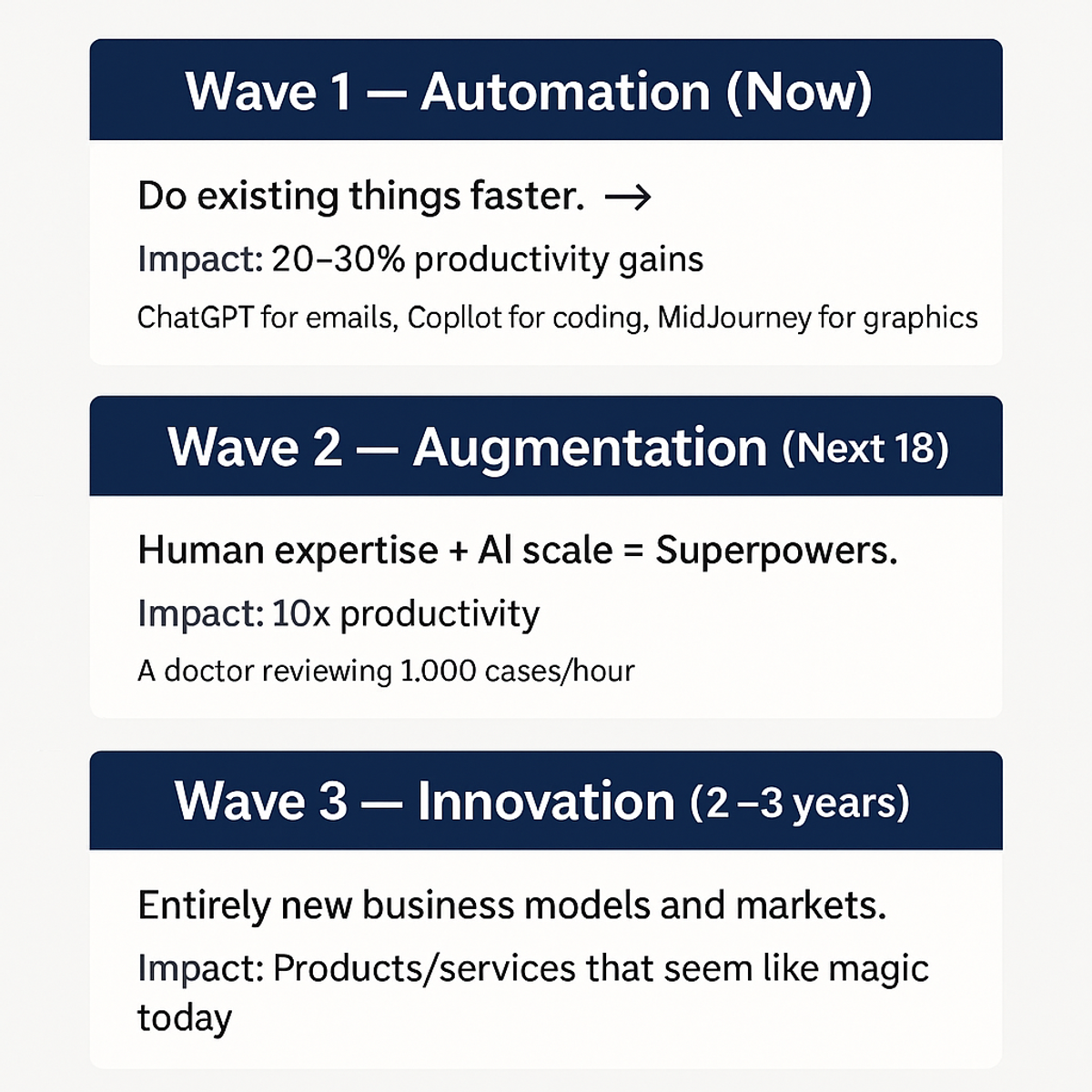
The Three Waves of AI Adoption (We’re Still in Wave 1)
Wave 1: Automation (Now)
Most organizations are here — using AI to do existing things faster. ChatGPT for emails. Copilot for coding. MidJourney for graphics. It’s powerful, but it’s just the beginning.
Impact: 20–30% productivity gains
Wave 2: Augmentation (Next 18 months)
This is where human expertise meets AI scale. Not replacing experts, but giving them superpowers. A doctor who can review 1,000 cases in an hour. An architect who can generate 50 design variations instantly. A teacher who can personalize lessons for every student.
Impact: 10x productivity gains
Wave 3: Innovation (2–3 years out)
Entirely new business models. Products that couldn’t exist without AI. Services that seem like magic today. This is where the real disruption happens.
Impact: New categories, new markets, new possibilities
The Participation Paradigm: Why Co-Creation Beats Competition
The old innovation model was linear: Company → Product → Customer
The AI-enabled model is circular: Company + AI + Customer → Co-Created Solution → Community
I recently witnessed this firsthand. A fintech startup used AI to analyze 10,000 customer conversations, identify patterns humans missed, then invited power users to co-design solutions in real-time using AI prototyping.
Result? Product-market fit in 6 weeks instead of 6 months. And customers became evangelists because they built it.
The Leadership Imperative: Orchestrate, Don’t Dictate
The most successful leaders I’m observing aren’t the ones with all the answers. They’re the ones creating environments where:
- Teams experiment fearlessly — Running 100 small AI experiments beats one big digital transformation
- Failure is data — Every “failed” AI use case teaches you what won’t work
- Speed trumps perfection — 70% accurate in one day beats 95% accurate in one month
- Everyone is a technologist — Your accountant might discover the best AI use case
Your Monday Morning AI Playbook
Stop strategizing. Start experimenting. Here’s how:
Week 1: The Pain Inventory
- List your team’s top 10 time wasters
- Identify 3 that are repetitive and rule-based
- These are your AI targets
Week 2: The Speed Run
- Pick one process
- Try 5 different AI tools on it
- Measure time saved, not perfection achieved
Week 3: The Scale Test
- Take your best result from Week 2
- Apply it to 10x the volume
- Document what breaks (this is valuable!)
Week 4: The Teaching Moment
- Share your results with your team
- Let them pick the next experiment
- Become the AI enabler, not gatekeeper
The Uncomfortable Truth
Here’s what nobody wants to say out loud: The companies that will thrive aren’t the ones with the best AI strategy. They’re the ones with the most AI experiments running right now.
While competitors form committees to discuss AI governance, AI-native leaders are already on their 50th iteration.
While traditional companies worry about perfect implementation, startups are shipping imperfect but improving AI features daily.
While incumbents protect yesterday’s advantages, insurgents are inventing tomorrow’s categories.
The Choice Is Yours
We stand at an inflection point. Not just technological, but psychological. The leaders who embrace AI as a creative partner rather than a threat will build the defining companies of the next decade.
The question isn’t whether AI will transform your industry. It’s whether you’ll be the one leading that transformation.
So I’ll leave you with three questions:
- What’s one process in your organization that you’ve always wished could be 10x faster?
- If you had unlimited analytical capacity, which customer problem would you solve first?
- What’s stopping you from running your first AI experiment today?
The future isn’t about humans versus AI. It’s about humans with AI versus humans without it.
Which side will you be on?
💡 I’d love to hear your thoughts: What’s the most innovative use of AI you’ve seen in your industry? What experiment are you running this week?
Drop a comment below or DM me. Let’s learn from each other.
#AI #Innovation #Leadership #FutureOfWork #DigitalTransformation #MIT #ArtificialIntelligence #BusinessStrategy #TechnologyLeadership #InnovationMindset
Follow for weekly insights on AI, innovation, and building the future.